
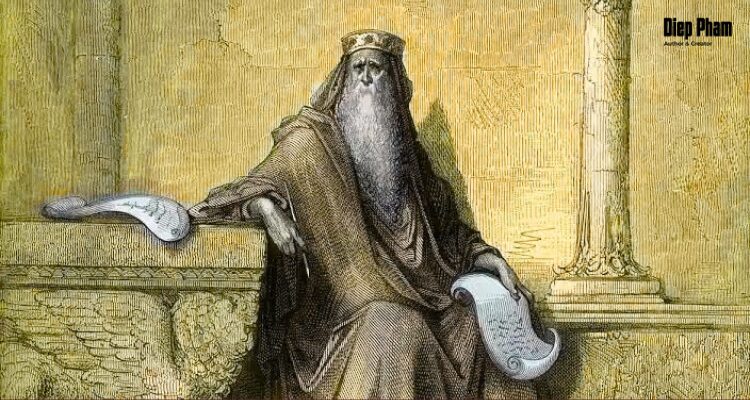
History whispers a strange paradox about the wealthiest man who ever walked the earth. We are told that King Solomon possessed gold in such abundance that silver was considered worthless in Jerusalem, like stones in the street.
We are told that kings and queens from distant lands traveled across dangerous deserts just to hear his voice, bearing gifts of spices and precious stones.
But if you look closely at the ancient records, you will find a detail that most modern seekers of success completely miss. Solomon never asked for gold. He never chased the market.
He never begged for power. In fact, the records state that gold chased him. Power bowed to him. This creates a frustrating question for the modern American, the entrepreneur, the dreamer who is currently grinding away their health for a sliver of what Solomon held effortlessly.
Why do we work harder than ever before, armed with technology and speed, yet feel more lost and less wealthy than we should? Why does the goalpost keep moving? The answer lies in a set of forgotten principles I call the Solomon Protocol wealth wisdom laws. These are not tips for your stock portfolio; they are the architectural blueprints for a mind capable of commanding reality.
We live in an age that has reversed the natural order of things. We are taught to chase the fruit—the money, the status, the accolades—while neglecting the root. We want the kingdom without becoming the king. But the Solomon Protocol suggests that this is an impossibility. You cannot have the dominion of a king with the mind of a servant.
When Solomon was offered the chance to ask for anything in the universe—long life, the death of his enemies, or vast riches—he bypassed them all. He asked for an “understanding heart” to discern between good and evil, to judge rightly. He understood the one truth that most men ignore: Wisdom is the root of all riches.
Not effort, not ambition, but understanding. Because his internal world was aligned with divine law, the external world of material wealth had no choice but to manifest around him.
This suggests that your current financial reality is not a reflection of the market or the economy, but a mirror of your internal understanding of law.
To understand this, we must look at the men in history who unwittingly applied the Solomon Protocol wealth wisdom laws to build modern empires. Consider Andrew Carnegie. He was a man who famously claimed he knew very little about the manufacturing of steel compared to the chemists and engineers he hired. Yet, he died one of the richest men in history.
How? Because Carnegie, like Solomon, understood that wealth is a byproduct of understanding human nature and universal law. He did not surround himself with people who flattered him; he surrounded himself with a “Mastermind” alliance of men who understood what he did not. He sought understanding above ego. There is a story I often tell of a reader of mine, let’s call him Michael, a bright young man from Chicago. Michael was the definition of the modern hustler.
He jumped from cryptocurrency to dropshipping to AI consulting, chasing every wave, barely sleeping, his nervous system fried by the age of thirty. He came to me broke, despite having made millions that slipped through his fingers.
I told him what I am telling you now: Michael, you are chasing the wind. You are trying to build a skyscraper on a foundation of sand. You have asked for money, but you have not asked for the wisdom to govern it.
Michael’s transformation didn’t happen because he found a better product to sell. It happened because he stopped running. He began to apply the first law of the Solomon Protocol: seek understanding first. He stopped asking “How do I make money?” and started asking “How does value work? How does trust work? Who must I become to be trusted with millions?” It took two years of quiet study, of rewiring his brain, of silencing the desperate need for quick cash.
Today, Michael runs a logistics logistics firm that operates with the precision of a Swiss watch. He works less than he did in his twenties, but he earns a hundred times more. Why? Because he became a magnet. When you understand the laws of the universe, you no longer have to chase opportunities; they seek you out because you are the only one capable of handling them.
This leads us inevitably to the second great pillar of the Solomon Protocol wealth wisdom laws, which is the governance of the inner world. Solomon wrote, “As a man thinketh in his heart, so is he.” In our modern world, we treat thoughts as if they are cheap, invisible, and inconsequential.
We let worry, fear, envy, and distraction run through our minds like wild dogs running through a fine restaurant. We would never let a stranger walk into our living room and smash our furniture, yet we let negative thoughts enter our minds and destroy our peace.
Solomon understood that the mind is the Throne Room. If there is chaos in the throne room, there cannot be order in the kingdom. You cannot master land, wealth, relationships, or business if you cannot first master your own reactions, your focus, and your inner speech.
Look at the life of Henry Ford. Ford was not a man of high formal education, but he was a master of the Solomon Protocol regarding the mind. He was known for his ability to hold a single vision in his mind—the V8 engine—against the doubts of all his engineers. They told him it was impossible.
They told him the physics didn’t work. Ford did not waiver. He did not let their doubt enter his “inner court.” He simply commanded them to try again. He ruled his thoughts so absolutely that his reality eventually bent to match his vision. This is what I mean by “Dominion.”
Dominion is not controlling other people; it is the absolute control of your own attention. If you cannot sit in a room for one hour in silence, focusing on a single aim without checking your phone or letting your mind wander to your anxieties, you are not yet ready to be rich. The marketplace punishes the distracted and rewards the focused.
I recall another reader, Sarah from London, a brilliantly talented architect who could never seem to break through the glass ceiling of her industry. Her designs were genius, but her bank account was empty. When we examined her life through the lens of the Solomon Protocol, we found that her inner court was filled with traitors.
She spent her mornings scrolling through social media, envying her competitors, telling herself she was behind, engaging in imaginary arguments with clients. She was exhausting her creative energy before she even sat at her drafting table. She was a queen who had let the court jesters take over the throne. We implemented a strict mental diet.
No inputs for the first two hours of the day. She had to write her “Definite Chief Aim” every morning. She had to treat every doubt as a hostile intruder and cast it out immediately. It was painful at first; her mind rebelled like a spoiled child. But within six months, the fog lifted.
Her energy returned. And suddenly, the high-ticket clients she had been chasing started calling her. They sensed a change. They sensed a woman who was centered, grounded, and in command.
But governing your thoughts is only half the battle; you must also govern your tongue. This brings us to the third, and perhaps most difficult, law of the Solomon Protocol wealth wisdom laws: the power of silence and restraint. Solomon said, “Even a fool is thought wise if he keeps silent, and discerning if he holds his tongue.”
In American culture, we are taught that the loudest person in the room is the most powerful. We are taught to sell, to pitch, to interrupt, to dominate the conversation. This is a lie. Real power is measured by restraint. The man who speaks everything he knows has emptied his treasury.
The man who listens, who waits, who holds his cards close, creates a vacuum that draws people in. Speech is not just expression; speech is creation. Every time you speak, you are legislating the laws of your life. When you say “I can’t,” or “It’s too hard,” or “I’m so tired,” you are issuing a decree that your subconscious mind must obey.
John D. Rockefeller, a man who understood the mechanics of empire better than perhaps anyone, was famous for his silence. In board meetings, while competitors panicked and shouted and spread rumors, Rockefeller would sit perfectly still, his face a mask, his hands folded.
He would listen. He would absorb. And when he finally spoke, his words hit the table like a gavel. He didn’t waste words because he didn’t waste power. He understood that silence is not passivity; it is the sharpening of the blade.
He knew that if you negotiate before you understand, you lose. If you react when you should pause, you lose. Most of the battles you have lost in your life—in business, in love, in family—were lost because you spoke too soon. You confessed weakness instead of commanding direction.
I challenge you to look at your own speech patterns. Do you use words to build, or to destroy? Do you speak to impress others, seeking their validation, which is a sign of a servant’s mind? Or do you speak only when it moves the needle of your purpose? I have seen men destroy deals worth millions because they could not endure five seconds of silence. They felt the need to fill the gap, and in doing so, they gave away their leverage.
To apply the Solomon Protocol, you must build a wall around your mouth. You must make a covenant that you will speak nothing that weakens your future, even in jest. You must become comfortable with the pause.
When someone insults you, the instinct is to snap back. The King, however, pauses. He considers the source. He considers the outcome. And often, he destroys the insult with a silence so profound that the insulter feels foolish. That is true power.
However, even a man who masters his mind and his tongue cannot rise alone. Wisdom multiplies, but it only multiplies in the right container. This leads to the fourth law: the principle of the Mastermind, or what Solomon called “Iron sharpening iron.” There is a dangerous myth of the “self-made man.” No such creature exists. We are all mosaics of the people we spend our time with.
Solomon did not share his deepest proverbs with the general public; he shared them with sons, with students, with those prepared to receive them. If you cast pearls before swine, they will trample them and then turn and tear you to pieces.
Many of you reading this are exhausted because you are trying to carry a vision while surrounded by people who anchor you to mediocrity. You share your dreams with friends who mock them.
You discuss your ambitions with family members who operate from fear. And you wonder why you feel drained.
Consider the relationship between Charles Schwab and Andrew Carnegie. Schwab rose to become the president of U.S. Steel not just because he knew steel, but because he vibrated at the same frequency of order and vision as Carnegie.
He placed himself in the atmosphere of greatness. Energy is contagious. If you sit at a table with five cynical, broke, complaining men, it is a mathematical certainty that you will become the sixth.
But if you sit at a table with five men who honor the Solomon Protocol wealth wisdom laws—men who govern their tongues, who seek understanding, who refuse to be victims—you will inevitably rise to their level.
I remember a reader named Raj from Mumbai. Raj was a brilliant programmer, but he was stuck in a circle of childhood friends who spent every evening drinking and complaining about the government and the economy. Raj felt guilty for wanting to leave them behind.
He felt that loyalty meant staying in the pit. I told Raj that loyalty to a poison is suicide. To rise, he had to purge. It was the hardest thing he ever did. He spent a year walking alone, which felt like a social death.
But in that vacuum, he began to attract a new tribe. He joined online communities of builders. He found mentors. Today, Raj is a CTO of a major tech firm, and his circle consists of men who challenge him, who hold him to his word, who do not tolerate mediocrity.
The Solomon Protocol demands that you ruthlessly curate your environment. You must ask yourself: “Who are my five? Would I trust them with my fortune? Do they feed my fire or douse it?” If the answer is no, you must have the courage to walk alone until you find the iron that sharpens you.
But even with the right mind, tongue, and circle, there is one thing that can still lead a man to ruin: a lack of purpose. Riches without purpose is poverty in disguise. This is the fifth law. We see this in the tragedy of the lottery winner who destroys his life within three years, or the celebrity who overdoses in a mansion. Money is simply energy. It is like water; it requires a channel, a direction.
If you accumulate a massive amount of water without a riverbed, you get a swamp. It stagnates. It rots. Solomon warned of the man who toils day and night to gather wealth, only to leave it to someone who didn’t earn it and doesn’t understand it. This is vanity.
You must look at Thomas Edison. He didn’t just tinker in a lab; he had a “Definite Chief Aim.” He envisioned a world lit by electricity. That purpose was the anchor that held him steady through thousands of failures. He wasn’t just trying to get rich; he was trying to move humanity forward.
Because his aim was clear, the wealth he generated had a place to go. It was reinvested into more invention, more progress. This is the difference between a river and a swamp. You must ask yourself: Why do I want this wealth? Is it to escape pain? Is it to prove my father wrong? Is it to buy toys that will bore me in a week? Those reasons are not strong enough to sustain the weight of glory.
You need a purpose that is bigger than your appetite. You need a vision that involves contribution. When you tie your financial goals to a purpose that serves others, you unlock a level of energy that the selfish man never accesses. The universe tends to support those who support the universe.
This naturally leads to the sixth law: The School of Failure. In the Solomon Protocol, failure is not a stop sign; it is data. It is instruction. The fool runs from failure and tries to hide his mistakes. The wise man hunts them down. He dissects them. Abraham Lincoln is the ultimate case study of this.
His life was a litany of losses—failed businesses, lost elections, the death of his fiancé, nervous breakdowns. A lesser man would have accepted the label of “victim.” But Lincoln possessed a mind that transmuted lead into gold.
He let his suffering carve out a greater capacity for empathy and wisdom. He learned from every political defeat how to better maneuver for the next one. He didn’t just “bounce back”; he bounced forward.
If you want to apply the Solomon Protocol wealth wisdom laws, you must change your relationship with pain. When you lose a deal, when you lose money, when you are rejected, do not wallow in self-pity. Do not blame the system.
Sit down, open your journal—your “Book of Errors”—and conduct an autopsy. What law did I violate? Did I speak too much? Did I trust the wrong person? Did I act out of impulse rather than principle? Extract the lesson, then burn the emotional baggage. A man who learns faster than he loses cannot be stopped. He becomes antifragile. The world throws stones at him, and he builds a castle.
Finally, we arrive at the practical application, the seventh law: The Daily Liturgy. How do you actually live this? You do not live it by thinking about it once a year. You live it by structure.
A kingdom without discipline collapses. Solomon’s court operated on a schedule; there was a time for judgment, a time for worship, a time for building.
You must bring this order to your own 24 hours. You must have a “Law of Rising”—owning your morning before the world steals it. You must have a “Law of Direction”—speaking your purpose aloud before you check your email. You must have a “Law of Work”—measuring your output, not just your busyness. You must have a “Law of Reflection”—auditing your day before you sleep.
This structure is your safety. When you don’t feel motivated, the structure holds you. When you are grieving, the structure holds you. When you are fearful, the structure moves you forward. Discipline is not a feeling; it is a temple you build brick by brick.
And this brings us to the highest truth, the capstone of the Solomon Protocol wealth wisdom laws, the conclusion of the matter. Solomon, at the end of his life, after having tasted every pleasure, built every building, and amassed every coin, boiled it all down to one sentence:
“Fear God and obey his commandments, for this is the whole duty of man.” Now, before you recoil at the religious language, understand the metaphysical reality he is pointing to.
To “Fear God” means to have reverence for the Source of all things. It means acknowledging that you are not the author of the universe. There are laws—gravity, cause and effect, polarity, rhythm—that were here before you and will be here after you.
To “obey the commandments” is to align yourself with the flow of reality. It means you stop trying to cheat the system. You stop trying to reap where you haven’t sown. You stop lying, because you know that a lie introduces a flaw into the structure of your reality that will eventually cause it to collapse.
You stop acting out of pride, because you know pride precedes a fall. You realize that you are a steward, not an owner. When you walk with this kind of reverence, you become dangerous in the best way. You become unbribable. You become unshakable. You are no longer working for the applause of men, but for the alignment with Truth.
I want you to imagine a life where you no longer drift. Imagine waking up tomorrow not with anxiety, but with a cold, calm command. You know exactly who you are. You know exactly where you are going. You do not speak idle words. You do not entertain foolish thoughts.
You do not waste time with people who drain you. You are building a legacy, brick by perfect brick, guided by the wisdom of the ages. This is the offer of the Solomon Protocol. It is not a get-rich-quick scheme. It is a become-a-king-forever path.
The power is not buried in the past. It is waiting in you. But you must choose it. You must pick up the pen and write your law. You must open your mouth and command your day. You must close the door and sit in the silence until you hear the voice of wisdom. The world is waiting for leaders who are governed by something higher than their own appetites. Will you be one of them?
I encourage you to save this post. Print it out. Read it every Sunday. And I want to hear from you in the comments below. Which of these laws have you been violating? Which one stings the most to read? Share your declaration of intent. Let the community here at DiepPham.Org be the circle of iron that sharpens you. Declare your “Definite Chief Aim” in the comments, and let us witness your rise. The time for drifting is over. The time for dominion has begun.
Thanks alot for reading, don’t forget to check out my collection of beautifully hand-crafted motivational quotes on Instagram to brighten your day HERE!
- Related Content: 15 Best Time-Management Books for Beating Procrastination
