

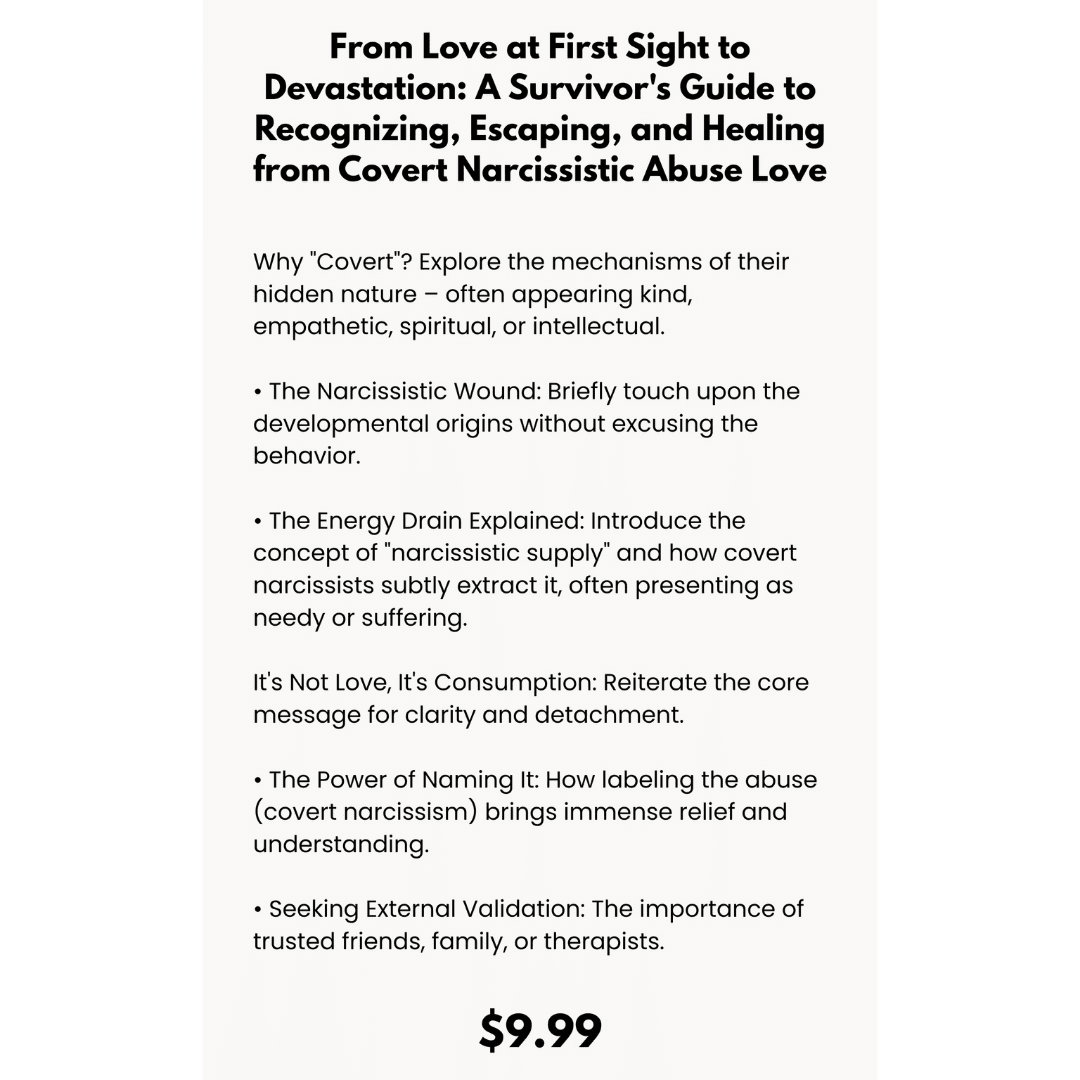
Covert Narcissist
$9.99
A Survivor’s Guide to Recognizing, Escaping, and Healing from Covert Narcissistic Abuse
Available on backorder
Description
– Target Audience:
Individuals who suspect they are (or have been) in a relationship with a covert narcissist, those seeking clarity and validation for their experiences, mental health professionals, and anyone interested in understanding complex psychological manipulation.
– Overall Tone:
Empathetic, validating, educational, yet uncompromisingly direct in exposing the tactics of covert narcissists. It aims to empower survivors with knowledge and actionable strategies, moving from confusion to clarity and healing.
– Book Outline:
Introduction: The Whisper of the Shadow
- Welcome to the Labyrinth: Acknowledge the reader’s confusion, pain, and the feeling of “something isn’t right.” Validate their intuition.
- The Invisible Enemy: Introduce the concept of covert narcissism as a form of insidious, often undetectable emotional abuse, distinct from overt narcissism.
- Why This Book Matters: Explain the critical need to understand this dynamic, especially for those who feel emotionally depleted and “used.”
- A Promise of Clarity and Liberation: Outline what the reader will gain: identification tools, escape strategies, and a path to healing.
- A Note on Language: Explain the use of terms like “emotional vampire” to metaphorically describe the energy-draining nature.
Part I: Unmasking the Chameleon – The Nature of the Covert Narcissist
Chapter 1: Beyond the Mirror – What is Covert Narcissism?
- The Spectrum of Narcissism: Differentiate between overt (grandiose) and covert (vulnerable) narcissism.
- The Wolf in Sheep’s Clothing: Delve into the core traits: hidden grandiosity, hypersensitivity to criticism, passive-aggressiveness, victim mentality, false humility, and a deep-seated sense of entitlement.
- Why “Covert”? Explore the mechanisms of their hidden nature – often appearing kind, empathetic, spiritual, or intellectual.
- The Narcissistic Wound: Briefly touch upon the developmental origins without excusing the behavior.
- The Energy Drain Explained: Introduce the concept of “narcissistic supply” and how covert narcissists subtly extract it, often presenting as needy or suffering.
Chapter 2: The Art of Soft Manipulation – How They Operate
- Gaslighting Lite: The subtle erosion of your reality – making you doubt your perceptions and sanity.
- The Victim Card Playbook: How they consistently present themselves as the injured party, garnering sympathy and deflecting responsibility.
- Emotional Blackmail (Soft Style): Guilt-tripping, silent treatment, and subtle withdrawal as tools to control.
- Triangulation and Smear Campaigns: How they subtly turn others against you or create drama to secure supply.
- Boundary Erosion: Their slow, persistent chipping away at your personal limits, often disguised as “closeness” or “understanding.”
- The Promise of Depth, The Reality of Shallowness: Discuss their pseudo-intellectualism or pseudo-spirituality.
Chapter 3: The Seduction of the Soul – Why You Were Drawn In
- The Illusion of Connection: How they mirror your deepest desires and create an intense, rapid bond (“love at first sight”).
- The Empath’s Trap: Why empathetic, compassionate, and giving individuals are prime targets.
- Your Untapped Potential: How they idealize specific traits (your stability, kindness, intelligence) that serve their needs.
- The Rescue Fantasy: Why you might feel compelled to “fix” or “save” them.
- The Promise of Reciprocity: The initial belief that they are equally invested in your well-being.
- Intermittent Reinforcement: The powerful neurological effect of inconsistent positive attention that keeps you hooked.
Part II: The Slow Burn – Living in the Narcissistic Labyrinth
Chapter 4: The Eight Signs You Weren’t Loved, But Used (Expanded)
- 1. Valued for Emotional Regulation, Not for Who You Are: Deep dive into how your presence stabilized their chaos, while your needs were ignored.
- 2. Intimacy Increased, Commitment Never Did: Explain the emotional bonding without structural responsibility, ensuring maximum access with minimal obligation.
- 3. Your Boundaries Triggered Subtle Withdrawal or Guilt: Illustrate the soft coercion to abandon your limits for “harmony.”
- 4. You Were Idealized for Your Traits, Not Seen as a Whole Person: How fixation differs from true intimacy; the destabilization when your humanity appears.
- 5. Their Interest Was Inconsistent but Intensely Focused: Explaining the trauma bonding and psychological dependency from intermittent reinforcement.
- 6. You Felt More Confused Than Secure: The strategic role of confusion in maintaining control.
- 7. Your Growth Threatened the Dynamic: How your self-awareness and independence undermine their supply, leading to devaluation or passive resistance.
- 8. When You Withdrew, They Panicked — Not Grieved: Differentiating between narcissistic panic (loss of supply) and genuine grief.
Chapter 5: The Toll on Your Soul – The Impact of Covert Abuse
- The Erosion of Self-Worth: How constant invalidation and subtle criticism chip away at your identity.
- Chronic Confusion and Brain Fog: The psychological and even physiological effects of gaslighting.
- Anxiety, Depression, and PTSD: The mental health consequences of living in a state of perpetual emotional uncertainty.
- Physical Manifestations: How stress and trauma can impact physical health.
- Isolation and Alienation: How they subtly separate you from your support system.
- The Trauma Bond: A detailed explanation of this powerful, addictive emotional attachment to the abuser.
- Feeling “Crazy”: Validating the common experience of feeling insane or hyper-sensitive.
Part III: Breaking Free – Your Path to Liberation
Chapter 6: The Moment of Clarity – Accepting the Truth
- The Lightbulb Moment: Acknowledge the difficulty and courage it takes to recognize the abuse.
- Dismantling Denial: Strategies for overcoming internal resistance and external gaslighting from flying monkeys.
- Validation is Key: Emphasize that your experience is real, valid, and not your fault.
- It’s Not Love, It’s Consumption: Reiterate the core message for clarity and detachment.
- The Power of Naming It: How labeling the abuse (covert narcissism) brings immense relief and understanding.
- Seeking External Validation: The importance of trusted friends, family, or therapists.
Chapter 7: Drawing the Line – Setting and Enforcing Boundaries
- Understanding Your Limits: Identifying your non-negotiables.
- The Art of the Gray Rock Method: Minimizing emotional engagement to cut off supply.
- Establishing Hard Boundaries: Practical steps for communicating and enforcing limits.
- Anticipating Resistance: What to expect when a covert narcissist’s supply is threatened (hoovering attempts, victimhood, rage).
- The Role of “No”: Reclaiming your power to refuse.
- Protecting Your Energy: Simple daily practices to shield yourself from their emotional demands.
Chapter 8: The Great Escape – Navigating Disengagement
- No Contact vs. Low Contact: Deciding the best strategy for your situation (e.g., shared children, work).
- Strategic Planning: Practical advice for preparing to leave or reduce contact.
- Dealing with Hoovering: How to recognize and resist their attempts to draw you back in.
- Managing Shared Responsibilities: Strategies for co-parenting or professional interactions.
- Building Your Support System: Reconnecting with trusted individuals and seeking professional help.
- The Guilt Trap: How to resist their attempts to make you feel bad for leaving.
Part IV: Reclaiming Your Self – Healing and Thriving
Chapter 9: The Phoenix Rises – Healing from Trauma Bond and Abuse
- Processing Grief and Loss: Grieving the relationship you thought you had, and the person you thought they were.
- Decolonizing Your Mind: Unlearning the distorted beliefs and self-doubt instilled by the abuse.
- Rebuilding Self-Esteem: Exercises and affirmations to reconstruct a positive self-image.
- Understanding Your Attachment Style: How past experiences might have made you vulnerable.
- Emotional Regulation for Yourself: Learning healthy coping mechanisms for your own emotions.
- Forgiveness (Not for Them, But for You): Releasing the burden of resentment and anger.
Chapter 10: Cultivating Authentic Connection – Learning to Love Again
- Redefining Love: What healthy, reciprocal love truly looks like.
- Identifying Red Flags: Learning to spot early warning signs of unhealthy dynamics.
- Trusting Your Intuition: Rebuilding faith in your inner guidance system.
- Building Healthy Relationships: Strategies for fostering genuine connection, respect, and emotional safety.
- The Power of Self-Love: Prioritizing your own well-being and needs.
- Your New Narrative: Writing a future where you are empowered, loved, and free.
Conclusion: From Shadow to Light
- Recap of Key Insights: Reinforce the core understanding of covert narcissism and its impact.
- Your Journey of Strength: Emphasize the incredible resilience and strength gained through this experience.
- The Gift of Clarity: How understanding empowers you to protect yourself and others.
- A Call to Action: Encourage continued self-care, boundary setting, and embracing authentic connection.
- Final Message of Hope: You are not alone, you are worthy of true love, and you can heal and thrive.
Appendix:
- Resources for further reading (books, websites, support groups).
- Glossary of terms (Gaslighting, Trauma Bond, Hoovering, etc.).
- Journal prompts for self-reflection.
Only logged in customers who have purchased this product may leave a review.


Reviews
There are no reviews yet.